
How to Improve Product Page Conversion Without Lowering Prices
Learn how to improve product page conversion without lowering prices by increasing clarity and confidence using labels, size charts, and trust signals.

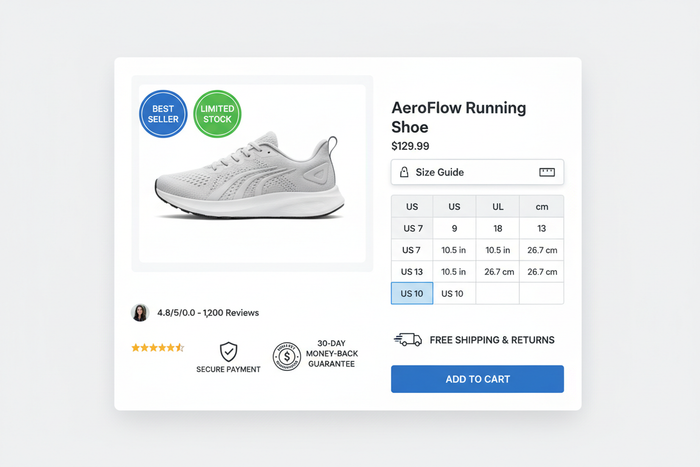
Discounts are often the first lever ecommerce brands pull when conversions slow down. But price is rarely the real problem. Most shoppers hesitate because they feel uncertain, not because products cost too much.
Conversion improves when product pages build clarity and confidence. This article explains how Shopify sellers increase product page conversion without lowering prices by using product labels, size charts, and trust signals.
Why Shoppers Hesitate on Product Pages
Every product page is a decision point. Visitors arrive with interest, but interest alone does not guarantee action. Hesitation appears when shoppers cannot answer a few critical questions quickly.
Common sources of hesitation include uncertainty about product quality, confusion around sizing or fit, and doubt about whether the product is right for their specific use case.
Even small gaps in information can create friction. When shoppers have to guess, they slow down. And when they slow down, conversion drops.
Importantly, hesitation does not always show up as abandonment. Many shoppers stay on the page, scroll, compare, or leave to “think about it later.” That delay is where conversions are lost.
Product Clarity as a Conversion Driver
High-converting product pages remove guesswork. They guide attention, surface key information early, and help shoppers feel confident in their choice.
Clarity is not about adding more text. It is about highlighting the right information at the right moment.
When shoppers understand what a product is, who it is for, and why it is a good choice, they move forward more easily. Confidence replaces doubt, and decisions happen faster.
Clarity-driven pages tend to share three traits:
- Important information is visible without excessive scrolling.
- Products are categorized and contextualized clearly.
- Uncertainty around fit, use, or compliance is addressed upfront.
Product labels and size charts play a central role in delivering this clarity.
Using Product Labels to Guide Attention
Shoppers do not read product pages line by line. They scan. Labels and badges work because they match this scanning behavior.
Labels such as “Best Seller,” “New Arrival,” or “Limited Offer” help shoppers instantly understand how a product fits within a collection. They act as visual shortcuts.
Instead of forcing customers to compare dozens of similar products, labels highlight what matters most. This reduces cognitive load and speeds up decision-making.
Effective product labels are not decorative. They are directional.
- They highlight popularity and social proof.
- They communicate urgency or exclusivity.
- They draw attention to promotions without changing prices.

When used consistently, labels guide shoppers toward high-intent products while reinforcing trust and professionalism.
On Shopify stores, dynamic product labels can be applied across collections, product pages, and promotional campaigns without altering core pricing.
Reducing Hesitation with Size Charts
Size uncertainty is one of the most common reasons shoppers abandon product pages or delay purchases, especially in apparel, footwear, and accessories.
When customers are unsure about fit, they hesitate. And when they hesitate, they either leave or plan to return later.
Clear size charts reduce this friction by giving shoppers confidence that they are making the right choice the first time.
Effective size charts do more than list measurements. They provide context.
- They explain how to measure correctly.
- They match real-world sizing expectations.
- They reduce the fear of ordering the wrong size.
By addressing fit concerns before checkout, size charts not only improve conversion but also reduce returns. This creates a long-term benefit beyond immediate sales.
When size guidance is accessible directly on the product page, shoppers feel supported rather than pressured.
Building Trust with On-Page Signals
Trust is not built through long explanations. It is built through small, visible signals that reassure shoppers at every step.
Badges, labels, and compliance elements contribute to a sense of legitimacy and professionalism. They show that the store is established, transparent, and customer-focused.
Trust signals work best when they are subtle and integrated naturally into the shopping experience.
- Product labels highlight credibility and demand.
- Size charts show attention to customer outcomes.
- Compliance elements demonstrate responsibility and care.
Together, these elements reduce friction and build confidence without aggressive persuasion.
How Shopify Sellers Implement This Without Coding
Many Shopify sellers understand the importance of clarity and confidence but struggle with execution. Custom development is expensive, and manual updates are time-consuming.
This is where purpose-built tools become valuable.
Lavar is designed as an all-in-one solution for Shopify merchants who want to improve product clarity and trust without touching code.
Instead of relying on theme edits or custom scripts, sellers use Lavar to:
- Apply product labels and badges consistently across their store.
- Add clear, customizable size charts directly to product pages.
- Display cookie banners that support transparency and compliance.
By centralizing these elements, merchants can focus on optimizing the shopping experience rather than managing technical complexity.
The result is a cleaner, more confident product page that converts better — without lowering prices.
Key Takeaways
Improving product page conversion does not require constant discounts. In many cases, it requires better clarity and stronger confidence signals.
Product labels help shoppers understand what matters. Size charts remove uncertainty. Trust elements reassure buyers that they are making the right decision.
When these components work together, conversion improves naturally — without sacrificing margin.
FAQ
Do product labels really impact conversion rates?
Yes. Labels guide attention and reduce decision friction, especially on collection and product pages with many similar items.
Can size charts reduce returns as well as increase conversion?
Absolutely. Clear size guidance helps customers choose correctly, leading to fewer returns and higher satisfaction.
Will adding more elements clutter my product pages?
Not when implemented correctly. Visual cues like labels and size charts work best when they are clean, consistent, and context-aware.
Do I need a developer to add these features?
No. Shopify merchants use tools like Lavar to implement labels, size charts, and trust elements without coding.
Is this approach suitable for new stores?
Yes. Clear product presentation and trust signals are especially important for new or lesser-known brands.


