
How to Use Product Badges to Sell More Without Discounting
Most stores discount to drive sales. There's a more margin-friendly way. Product badges create urgency and social proof without touching your price.

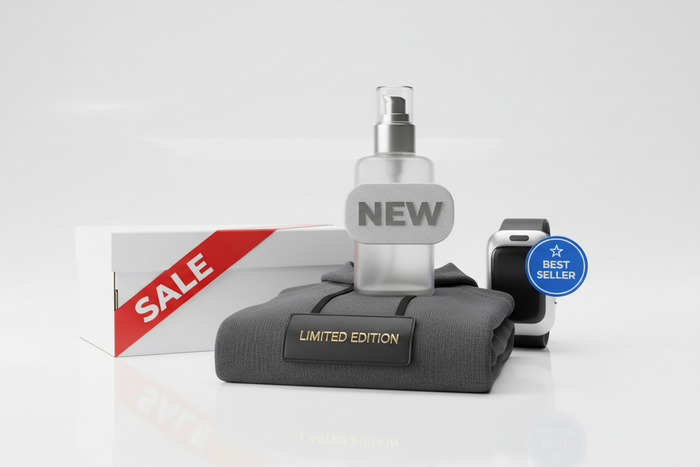
Discounting is the default growth lever for most Shopify stores. Sales spike during promotion periods, then fall back. Margins compress. Customers start waiting for the next discount before buying at full price. The brand gradually trains its own audience to expect a deal.
There's a better lever for driving sales that most merchants underuse: product badges. A well-placed badge communicates value, urgency, or social proof at the exact moment a shopper is evaluating a product — without touching your price.
This isn't a minor UX improvement. It's a fundamentally different approach to conversion that preserves margin while still giving buyers the signals they need to decide faster.

Why Stores Default to Discounting
Discounting works in the short term because it's legible. "20% off" is a clear, immediate signal that requires no interpretation. Shoppers understand the value proposition instantly, and the urgency is built in — either the deal ends or the product sells out.
The problem is that discounting trains buyer behavior over time. When a store runs frequent promotions, customers learn to wait. Full-price conversion drops not because the product is less desirable, but because the buyer expects the price to drop. This is especially damaging in fashion and lifestyle ecommerce, where repeat purchase behavior is the foundation of long-term revenue.
It's also a structural margin problem. A 20% discount on a product with a 40% gross margin cuts that margin in half. Run enough of those promotions and the store's economics quietly deteriorate even as revenue holds steady.
Product badges don't have this problem. They create the same buying triggers — urgency, social proof, differentiation — without requiring you to reduce what you earn per sale.
What Badges Actually Do for Conversion
Badges work because buying decisions are faster than most merchants realize. On a collection page, shoppers scan products in seconds. On a product page, the evaluation window before a decision to continue or exit is short. Badges inject information into that window in a format that doesn't require reading.
A "Best Seller" badge communicates three things simultaneously: this product is popular, other people have chosen it, and choosing it is lower-risk. That's social proof compressed into two words. A shopper who was uncertain becomes less uncertain — not because anything about the product changed, but because they received a trust signal at the right moment.
A "Low Stock" badge operates differently but just as effectively. It creates urgency without manufacturing a fake deadline. If the stock information is accurate, this badge is honest — and buyers respond to real scarcity in a way that they don't respond to countdown timers they've learned to ignore.
A "New Arrival" badge solves a different problem: directing attention to products that haven't yet built social proof. New products are at a conversion disadvantage because they have no reviews, no purchase history, no visible demand signals. A "New Arrival" badge doesn't replace those signals, but it reframes the newness as a feature rather than a liability — this is fresh inventory, not untested product.

The Right Badges for the Right Contexts
Not every badge works in every context. The impact of a badge depends on where it appears, which product it's applied to, and what the shopper is trying to figure out at that moment.
- Best Seller — highest impact on collection pages where shoppers are still deciding which product to click. Reduces choice fatigue and directs attention toward proven performers. Apply to top 10–15% of products by sales volume, not everything.
- New Arrival — effective on both collection and product pages for recently added inventory. Works best in fashion and trend-driven categories where freshness itself is a value signal. Set a time window — only products added in the past 30–60 days should carry this badge.
- Low Stock — most powerful on product pages where the buyer has already expressed interest. Accurate stock count is critical; this badge loses credibility if overused or applied to products with deep inventory.
- Sale — the one badge that does involve price, but used selectively it's more honest than blanket sitewide discounting. Apply to specific SKUs rather than entire collections to preserve full-price perception on the rest of the catalog.
- Eco-Friendly / Sustainable — increasingly relevant in fashion and home categories where sustainability is a purchase factor. Communicates a value that price can't express and reaches buyers who are specifically looking for that attribute.
How Lavar Makes This Actionable
Lavar is a Shopify app that lets merchants add product labels, badges, and size charts to their storefront without editing theme code. The badges are dynamic, meaning they can be tied to product conditions — inventory levels, tags, collections — rather than requiring manual updates per product.
Badge placement, color, and style are customizable to match brand design — so badges feel like part of the store, not third-party overlays. This matters more than it sounds. Shoppers are more likely to trust a badge that looks intentional and on-brand than one that looks like it was added with a plugin.
The size chart feature in Lavar is worth mentioning in this context because it directly supports the same goal as badges: reducing the uncertainty that prevents buyers from committing. A buyer who reads a "Best Seller" badge but still isn't sure of their size hasn't had their objection fully resolved. A size chart next to the size selector closes that second gap. Lavar handles both in one install, which means the trust infrastructure around each product can be built without stacking multiple apps.

For stores targeting EU markets, Lavar also includes a GDPR cookie banner — a compliance requirement that most stores handle separately. Having it in the same app reduces the number of tools in the stack without losing functionality.
Building a Badge Strategy That Protects Margin
The goal of a badge strategy is to replicate the conversion impact of promotions without the margin cost. That means being deliberate about which badges go where, and resisting the temptation to over-badge.
A product page with five badges is no different from a page with none — both are noisy, and neither guides the buyer. The most effective badge strategies use one or two badges per product, chosen based on what the shopper needs to know at that stage of evaluation.
Start with a simple framework:
- Collection pages: one badge per product maximum, prioritizing social proof signals (Best Seller, New Arrival).
- Product pages: one urgency or trust signal (Low Stock, Best Seller) placed near the add-to-cart area where it has maximum impact on the final decision.
- Seasonal or campaign-specific badges: deploy for a specific window, then retire. Permanent "Special Offer" badges train buyers to ignore them.
Review badge assignments monthly. A product that earned "Best Seller" status six months ago may no longer be your top seller. A "New Arrival" badge on a product that's been in your catalog for two months loses credibility. Keeping the data accurate keeps the badges trustworthy.
Final Thoughts
Discounting is a tool, not a strategy. Used occasionally, it moves inventory and rewards loyal customers. Used habitually, it erodes margin and trains buyers to wait. The stores that grow revenue without constantly compressing margin tend to have strong product page infrastructure — clear positioning, visible social proof, honest urgency signals — that does the conversion work without touching the price.
Product badges are one of the simplest ways to build that infrastructure. Applied correctly through Lavar, they give shoppers the signals they need to decide — without requiring you to give anything away on price. That's a trade worth making.
FAQ
Do Product Badges Actually Improve Conversion or Are They Just Visual?
Done correctly, they improve conversion by reducing the uncertainty that causes shoppers to hesitate or exit. A "Best Seller" badge lowers perceived risk. A "Low Stock" badge creates genuine urgency. The key is accurate data and intentional placement — badges that feel credible influence behavior; badges that feel generic get ignored.
How Many Badges Should I Use per Product?
One to two per product is the effective range. More than that creates visual clutter and dilutes the impact of each badge. On collection pages, one badge per product card is the ceiling. On product pages, one badge near the purchase area typically has more impact than multiple spread across the page.
What's The Difference Between A Badge Strategy And A Discount Strategy?
A discount strategy reduces price to create conversion. A badge strategy creates conversion signals without reducing price. Both influence buyer behavior, but badges preserve your gross margin per sale. Over time, a badge-first approach avoids training customers to expect discounts before buying.
Can I Apply Badges Dynamically Based on Inventory or Sales Data?
Yes, with Lavar you can tie badge display to product conditions like inventory levels or product tags, so badges like "Low Stock" can reflect real-time data rather than requiring manual updates per product.
Does Lavar Work on All Shopify Themes?
Yes. Lavar is designed to work across all Shopify themes without custom code changes. Badges and labels are customizable in color, style, and placement to match your store's existing design.


